| Research Note Markets 21 July 1998 |
Year 2000 World
Status 2Q98 Update - A Summary Report |
We provide an update of our world status by industry and country, for high-level risk assessments of customers, supply chains, investments, economies, global businesses, markets, governments and country infrastructures.
Core Topics
Applications Development: Year 2000 Date Crisis Management and Infrastructure
Key Issues
How well will GartnerGroup research forecast future events?
What strategies and methodologies will enterprises adopt to launch and manage year 2000 compliance projects?
GartnerGroup has conducted another round of worldwide surveys of companies and country government agencies. Fifteen thousand companies in 87 countries were surveyed to capture information related to their status, methods, strategies, plans and costs. Companies and government agencies were rated by size, by industry and by country. Their status is described using the GartnerGroup COMPARE scale (see Note 1).
Note 1
COMPARE Levels
The GartnerGroup COMPARE scale (see ADM Research Note SPA-980-1464, 15 April 1997) was used to define status. This scale defines five levels of compliance efforts.
Benefits of This Research
Companies and government agencies may use this data to assess global, partner and customer risks.
The year 2000 market may be better analyzed and planned for by year 2000 service and tool providers, based upon market status and opportunity windows concluded from this research.
Companies and government agencies may compare their status and progress against the updated status of their industry, competitors and other countries.
Twenty-three percent of all companies have not started any year 2000 effort. More than 80 percent of these are small companies. 93 percent of IT budgets remained flat or were reduced from 1997 to 1998. Five percent of IT budgets were spent on year 2000 efforts in 1997, and nearly 30 percent is planned to be spent in large companies in 1998, which are also planning to spend 44 percent in 1999. Eighty-seven percent of large companies will supplement their internal resources with external consulting amounting to 6 percent of their internal IT resources. Large companies using external software factories will send out up to 7 percent of their source code for remediation. In 1997, 97 percent of started companies used vendor survey letters to determine vendor compliance, while only 71 percent continue to use this method. In 1998, 19 percent have already begun to require vendor face-to-face meetings to determine compliance of mission-critical, vendor-provided IT solutions, since survey letters have proven to be an inaccurate method of assessment. Twenty-three percent of started companies have begun researching supply chain risks, and 11 percent have begun to research embedded system risks. Fifty percent of all companies are not planning to perform any year 2000 testing, as they intend to fix code and install to production.
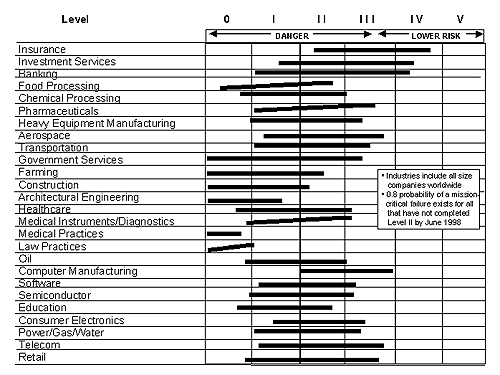
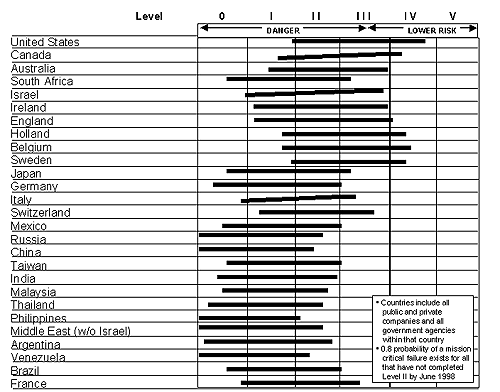
Figure 1 and Figure 2 show COMPARE level status by industry (see Note 2) and by geography (see Note 3). On each status bar showing COMPARE level status, on average, 25 percent of the bar farthest to the right represents large companies, the 25 percent farthest to the left represents small companies, and the middle 50 percent represents midsize companies (see Note 4).
Figure 1
Status by Industry - Worldwide (Table:00071191001.gif)
Source: GartnerGroup
Figure 2
Status by Geography - Worldwide (Table:00071191002.gif)
Source: GartnerGroup
Note 2
Industry Status
Insurance, investment services and banking are industries furthest ahead. Healthcare, education, semiconductor, chemical processing, agriculture, food processing, medical and law practices, construction and government agencies are furthest behind. Telecom, power, gas and water, software, shipbuilding and transportation are laggards barely ahead of furthest-behind efforts.
Note 3
Geographic Status
All public and privately owned companies (all industries and all sizes) and government agencies are included in these country positions. The United States, Canada, The Netherlands, Belgium, Australia and Sweden are leaders, while Eastern Europe, Russia, India, Pakistan, Southeast Asia, Japan, most of South America, most of the Middle East and Central Africa all lag the United States by more than 12 months. Most of Western Europe is 6 months behind the United States, except for Germany, which is 12 months behind, and France, which is eight to 10 months behind. Israel is eight months behind the United States, but the rest of the Middle East is 12 to 18 months behind the United States. The U.S. government leads all other country governments by an even wider margin than the companies in those countries. Most government agencies are significantly behind the United States and extremely lagging overall.
Note 4
Company Sizes Used
Small = 20 to 2,000 employees; Midsize = 2,000 to 20,000 employees; Large = more than 20,000 employees
Predictions
In July 1998,15 percent of companies claim to have achieved completion of COMPARE level IV and achieved operational sustainability. We predict that 50 percent of companies will achieve this goal by 2000. The majority of large companies in the United States will see a minimal number of mission-critical failures through the millennium. Companies in lagging countries, midsize and small companies, government agencies in lagging countries and companies within lagging industries will experience higher numbers of significant failures. Economic issues will dominate the negative impact of year 2000 through 2003 (0.9 probability). Catastrophic failures will not occur everywhere in January 2000, but failures in less developed countries, smaller companies and companies with high global dependencies will cause a negative impact to the world economy (0.9 probability).
Bottom Line: Clients that have suppliers in the danger zone should focus quickly on them, and clients that are in an identified danger zone, but are actually further advanced than their peers, should publicize that fact to their customers.
| This document has been published by: | ||
|---|---|---|
| Service | Date | Document # |
| PRISM for Applications Development | 21 July 1998 | M-04-6957 |
| Year 2000 Issues and Services | 21 July 1998 | M-04-6957 |
| Year 2000 Strategies | 21 July 1998 | M-04-6957 |

Entire contents (C) 1998 by Gartner Group, Inc. All rights reserved. Reproduction of this publication in any form without prior written permission is forbidden. The information contained herein has been obtained from sources believed to be reliable. Gartner Group disclaims all warranties as to the accuracy, completeness or adequacy of such information. Gartner Group shall have no liability for errors, omissions or inadequacies in the information contained herein or for interpretations thereof. The reader assumes sole responsibility for the selection of these materials to achieve its intended results. The opinions expressed herein are subject to change without notice.